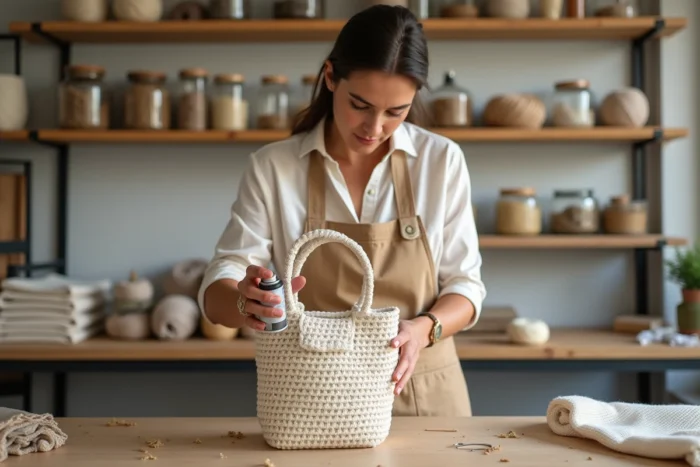
A crocheted bag loses its shape as soon as a heavy object is placed inside because the stitches, even when tight, leave some play between each loop. Reinforcing a crocheted bag means compensating for this structural play by choosing an appropriate yarn, adding internal support, or applying a surface treatment. The effectiveness of each method depends on the fiber, the stitch used, and the intended use of the bag.
Cotton rope in the handles: limit stretching without weighing down the crocheted bag
The elongation of the handles is the first visible sign of a bag that lacks structure. The yarn, subjected to constant tension, gradually stretches and distorts the silhouette of the bag. Acting on the handles even before treating the body of the bag radically changes the overall hold.
The technique involves sliding a cotton or macramé rope inside a row of tight stitches while crocheting the handles. The rope acts as a flexible frame, absorbing the tension in place of the yarn and preventing elongation. English-speaking crochet designers like Sweetpeafamily and TLYarnCrafts have recommended this approach for several seasons, but it remains poorly documented in French tutorials.
To achieve a clean result, simply choose a rope whose diameter matches the height of the tight stitch. You crochet over the rope, enclosing it in each stitch. The result is a handle that does not move, without excessive rigidity or noticeable additional weight. Those who wish to delve deeper into the subject can stiffen a crocheted bag with Allure Mode by consulting the detailed complementary techniques for each type of yarn.
Thermoformable reinforcements on lining: durable stiffening for crocheted bags
Treating only the outside of the bag (spray, starch, resin) is not enough for everyday use. The most reliable method separates the reinforcement from the crochet by using an intermediate textile lining.
Principle of the lining-reinforcement sandwich
A thermoformable interfacing (such as Decovil I, Decovil II, G700, or S320 from Vlieseline) is fixed with an iron onto a lining fabric. This reinforced lining is then sewn inside the crocheted bag. The reinforcement never comes into direct contact with the stitches, preventing localized distortions and glue marks on the yarn.
The separation between reinforcement and crochet also protects the stitches during washing. The bag can be cleaned without the interfacing peeling off or warping, provided the washing temperature indicated by the manufacturer of the fusible interfacing is respected.
Choosing the right weight of fusible interfacing
An interfacing that is too light will not hold up against the weight of the contents. An interfacing that is too rigid will turn the bag into a box. The choice depends on the size of the bag and what you plan to put in it.
- For a small evening bag or pouch, a soft interfacing like G700 is sufficient to maintain the shape without breaking the drape of the crochet.
- For a shopping bag or tote, a Decovil I (denser, with a thick adhesive side) offers a hold comparable to that of soft leather.
- For a structured bag like a bucket or rectangular shape, the S320 or Decovil II, which are significantly firmer, provide walls that do not sag even when empty.
These references from the Vlieseline brand are used in artisanal leather goods. They can be found in specialized haberdasheries, but rarely in large supermarkets.
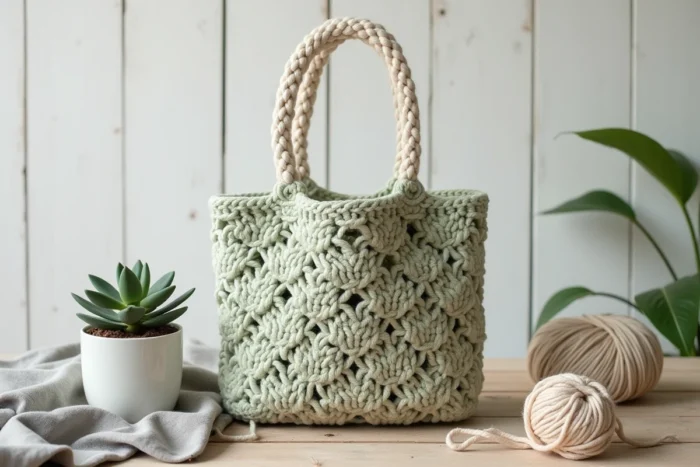
Rigid bottom in plastic or cardboard: stabilize the base of the crocheted bag
The bottom is the area that undergoes the most mechanical stress. Even with reinforced walls, a soft bottom allows the contents to sag and pulls on the sides of the bag.
A rigid plastic sheet cut to the exact dimensions of the bottom (like plastic canvas grid, available in haberdasheries) slides between the lining and the crocheted bottom. It distributes the weight over the entire surface instead of concentrating it in the center. Plastic is resistant to moisture and friction, making it suitable for everyday use.
Thick cardboard (such as gray bookbinding cardboard) also works, but it deforms when in contact with water. For a bag intended to carry groceries or exposed to rain, plastic remains the most durable choice. The cardboard bottom is better suited for an indoor bag or a decorative project.
Hook tension and stitch choice: act on rigidity from the first stitch
No reinforcement will fix a crocheted bag made with loose stitches and overly soft yarn. Rigidity is built from the choice of yarn and the size of the hook.
Using a hook half a size to a size smaller than the recommendation on the yarn label tightens the stitches and reduces the play between each loop. The resulting fabric is denser, heavier per square meter, and deforms significantly less under load.
The choice of yarn is as important as the tension. Less stretchy yarns yield the best results for structured bags:
- The raffia yarn (natural or synthetic) produces a naturally rigid fabric, suitable for summer baskets and totes.
- Unmercerized cotton, which is rougher than mercerized cotton, grips better between stitches and limits slipping.
- Raffia yarn (in cotton or recycled polypropylene) provides a flat and structured finish without additional reinforcement, as long as you crochet tightly.
Feedback from professional crocheters converges on one point: bags that last the longest combine a less stretchy yarn, tight stitches, and a sewn internal structure. Methods based on starch or homemade glue do not hold up over time for regular use.
Starch and hardening sprays: a temporary solution for crocheted bags
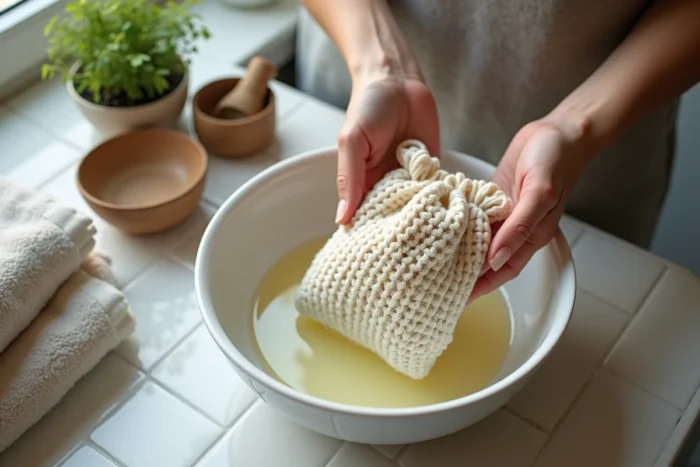
Diluted corn starch in water, applied with a brush or by soaking, temporarily stiffens the stitches. The bag regains some structure once dry, but the rigidity disappears at the first contact with moisture or after a few weeks of use.
Commercial textile starch sprays work on the same principle. They leave a film that stiffens the fiber on the surface. The result is suitable for a decorative bag, a photo project, or a display piece. For an everyday bag, starch does not replace mechanical reinforcement.
The combination of both approaches (surface starch and reinforced lining inside) provides the best compromise between aesthetics and durability. The starch takes care of the outer drape, while the fusible interfacing ensures structural hold over the long term.