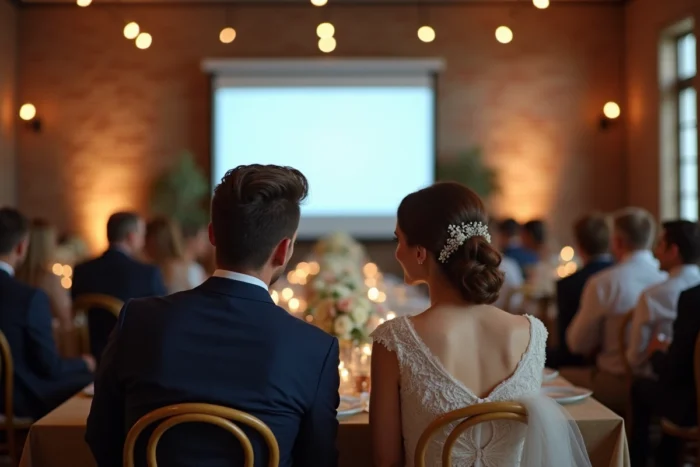
A wedding slideshow refers to a projection of photos (and sometimes short videos) that recounts the couple’s story, shown to guests during the reception. Its duration directly affects the emotional impact of the moment: too short, it frustrates; too long, it distracts the attention of the room.
Guests’ attention span: the constraint that sets everything else
Before discussing the number of photos or musical choices, a technical fact must be established. Wedding animation specialists indicate that a slideshow exceeding 10 minutes leads to a drop in attention, even among the most involved relatives.
An event guide published by ABC Salles goes further: a 20-minute slideshow is perceived as just as tedious as an endless speech. The comparison is telling because every guest has endured a speech that was too long and remembers it.
This 10-minute threshold is not arbitrary. It corresponds to what public speaking professionals recommend for wedding speeches, typically lasting between 3 and 7 minutes. The slideshow, which engages a passive audience (seated, without interaction), can tolerate a bit more, but not much. You can find wedding tips on La Mariée Rêveuse to delve deeper into this timing issue.
Wedding slideshow duration: the range that works in practice
The recommended range is between 5 and 10 minutes. Below 5 minutes, the editing seems rushed and doesn’t allow time for emotion to settle. Beyond 10 minutes, the audience disengages.
What this range implies in terms of the number of photos
With a display duration of 4 to 6 seconds per photo (including transitions), a 7-minute slideshow contains between 70 and 100 photos. This volume is sufficient to cover the childhood of both newlyweds, their meeting, and some key moments with loved ones.
Exceeding 120 photos either forces a reduction in time per image (the editing becomes frantic) or requires extending the projection beyond the critical threshold. In both cases, the effect is counterproductive.
Adapting the duration to the time of day
A slideshow shown during the cocktail hour, where guests mingle and chat, can loop on a shorter format (3 to 5 minutes). Projected during the meal, between courses, it benefits from a captive audience and can easily reach 8 to 10 minutes.
The worst time slot: after midnight, when some guests are dancing and others are starting to tire. At this point, even 5 minutes feels long.
Editing and music: the levers that alter the perception of time
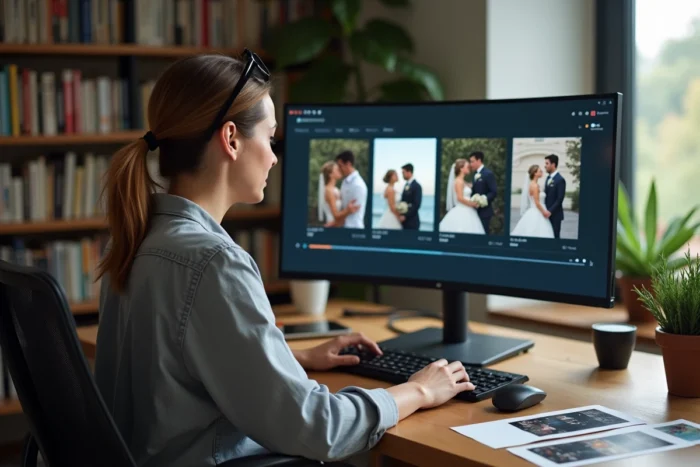
The raw duration doesn’t tell the whole story. A poorly timed 8-minute slideshow will feel longer than a well-constructed 10-minute edit. Two variables radically change the guests’ perception of time.
- The musical choice structures the rhythm. Two or three tracks are sufficient for a 7 to 8-minute slideshow. Alternating a soft song with a more upbeat track avoids monotony and creates tonal shifts that recapture attention.
- Transitions between photos should remain simple. Spectacular effects (3D rotation, shattered mosaic) slow down the perceived pace and age poorly. A classic crossfade remains the smoothest.
- Inserting a short video sequence (10 to 15 seconds, no more) among the photos creates a surprise effect that “resets” the room’s attention. A filmed testimonial excerpt or a short message from the couple works very well.
Live slideshow: when the fixed duration no longer applies
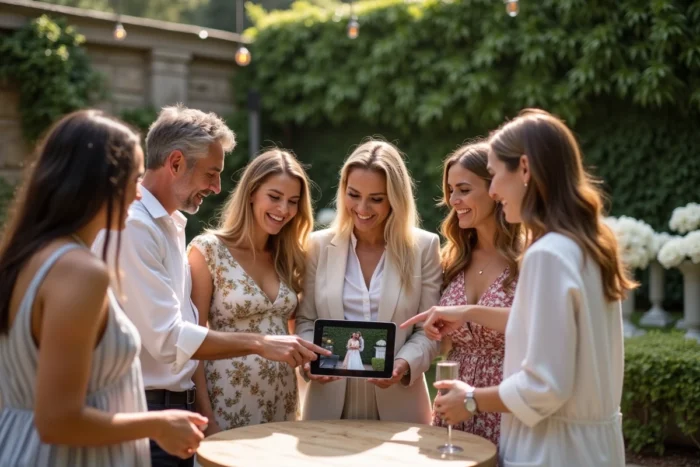
Live slideshow tools change the game. The principle: photos taken by guests during the evening automatically display on a screen, with only a few seconds of latency. The projection becomes a continuous animation rather than a timed sequence.
This format does not replace the classic slideshow (which tells the couple’s story), but it complements it. Shown in the background during the meal or on the dance floor, it requires no pause in the evening’s flow and does not impose a fixed duration.
The distinction is useful: the narrative slideshow (with editing, music, and photo selection) remains subject to the 5 to 10-minute constraint. The live slideshow, on the other hand, functions like a collective photobooth projected continuously.
Duration errors that can ruin a wedding slideshow
Three pitfalls consistently appear in feedback from couples and vendors:
- Trying to include “all the photos” for fear of offending someone. The selection is the most challenging yet most crucial part. A successful slideshow is one where a lot has been cut.
- Setting the duration based on the length of a favorite 6-minute song, then adding “just one or two photos” to a second track. The marginal addition pushes the edit into the disengagement zone.
- Starting the projection without testing the output in real conditions. A screen that is too small in a well-lit room, poorly adjusted sound, and guests will disengage in 2 minutes, regardless of the planned duration.
The most effective format for a wedding slideshow remains an edit of 6 to 8 minutes, set to two well-chosen music tracks, with 80 to 100 carefully selected photos. The rest, the guests will see in the album.