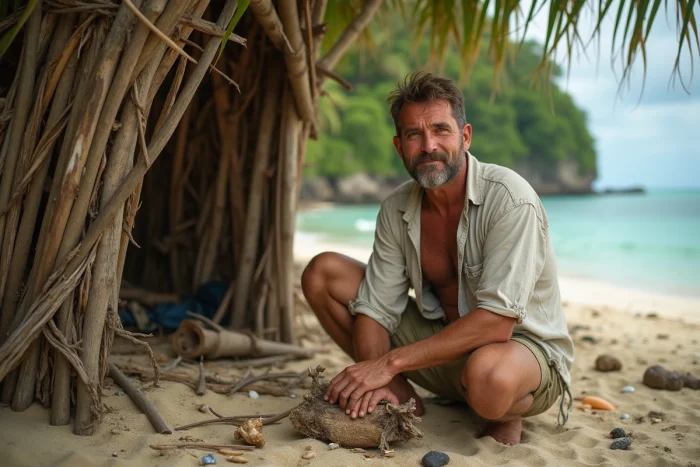
99.8% of shipwrecked individuals swallowed by the ocean vanish without leaving a trace. Yet, sometimes, chance fractures this fatality: it takes just one man, one superhuman trial, to break the silence. This is the essence of Cast Away: the film does not invent a hero; it relies on raw, stripped-down reality, where fiction adheres to lived experience.
In the year 1985, somewhere in the Pacific, a FedEx employee disappears at sea. Two days pass, a deadline beyond which, statistically, every minute adds another chance for forgetfulness. But the story clings to its irreducible will to live: no halo of a hero, just an unyielding strength, one that can be found even in the most earthly details of the feature film.
The rescue operations are also tangled: scrambled signals, paralyzed decision chains. Everyone moves forward blindly. Diving back into this archive file means rediscovering the groping urgency, a tension that pierces the simple adventure narrative. The film never falls into exaggeration or flashy elements: it adopts this uncertainty, this permanent irresolution, where reality needs no artifice.
Behind the fiction, a solid grounding in lived experience
Where other works adorn the story with flamboyance, this one chooses rigor, sometimes to the point of dryness. Tom Neale, spending sixteen years on a remote Pacific islet, has shaped his own survival down to the millimeter. On his island, nothing is ever taken for granted: every habit must be invented, every resource rediscovered.
Before writing a single scene, William Broyles Jr. immersed himself for many months in notes, journals, and accounts of real castaways. Through his readings, he discovers the true story behind Cast Away, a striking trajectory that gradually dissolves the barrier between drama and reality. The film captures fear, fatigue, surprise, without ever embellishing.
When the crew isolates itself on Monuriki, the island asserts itself, raw, without any concession. Dust, salt, fatigue: everything marks the bodies. Tom Hanks transforms, physically diminished, until he fades behind a face closed off by the ordeal. The music gives way to silence, the sounds of wind, waves, and hunger. Even the name FedEx becomes a relic, the last thread connecting the castaway to a world that remains only in memory.
Alexander Selkirk or solitude as survival
Tracing back leads to Alexander Selkirk, an 18th-century sailor left alone for four years on a lost island. For him, everything is bought with strength: repairing, finding food, battling daily against hunger, fear, exhaustion, and, above all, maintaining a breath of humanity. His story will inspire the indelible figure of Robinson Crusoe, that of a man standing on a hostile rock, defying total disappearance.
Cinema, like a tenacious witness, resurrects this survivor: it forces the viewer to confront emptiness and waiting. “Cast Away” takes up the torch, absent birds and wavering certainty, leaving only one word etched: endure, even when everything collapses.

Tom Hanks: dissolving the character to reveal the solitary man
The preparation for the film goes beyond readings: the screenwriter wanted to experience, on a deserted island, what it means to lose all bearings. Even in a controlled setting, insecurity destabilizes. On screen, this experience bursts forth: words fade, every gesture becomes precious. Hanks changes everything to the extreme, with restricted diet, an unruly beard, and a silhouette reduced to fatigue, to align with the reality of survival without any grandstanding.
The sound atmosphere itself follows this tightening: long, heavy silences, a hoarse voice, rustlings as the only companions. That Wilson, a volleyball, becomes the sole interlocutor is not a whim or a comic effect. It is what separates survival from inner shipwreck: a struggle against nothingness and silence, where the slightest object can become a refuge for fragments of humanity.
The projector turns off, the room empties. Yet, in this silence of the end, one question lingers, almost visceral: in the face of the great void, what would each person invent to escape total disappearance?