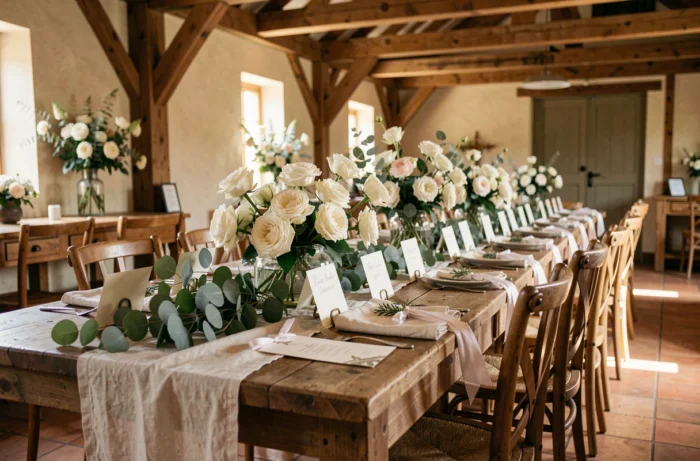
When you start looking for wedding decoration ideas, you quickly come across the same lists: fairy lights, wooden centerpieces, pastel color palettes. The problem isn’t that these ideas are bad. It’s that they don’t say anything about how to assemble them to achieve a coherent result, transportable from one space to another, and that holds up from morning to night.
Let’s approach the topic differently: start from the concrete constraints of the venue and the flow of the day to build a wedding decoration that really works, not just in photos.
Floral arrangements without foam: what it changes on the ground
Floral foam (oasis) has long been the foundation of any wedding arrangement. You would stick the stems into it, and you would get a dense and stable result. The issue is that it disintegrates, is not reusable, and complicates the teardown at the end of the evening.
For a few years now, wedding florists have been working with alternative structures: shaped wire, individual water tubes, reusable containers. The visual result remains generous, but the arrangements become modular. They can be moved from one point to another without having to redo everything.
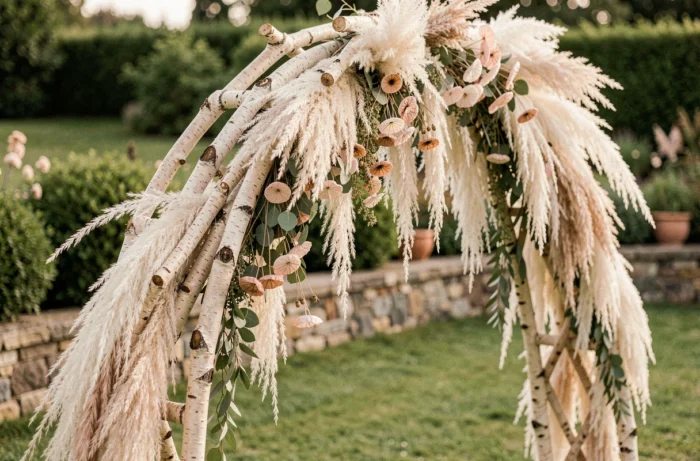
In practice, this means that a ceremony arch filled with flowers can be partially dismantled during the cocktail to supply the centerpieces. The bouquets from the head table can end up as decoration for the photobooth. By looking for references on the decoration page of Mariés de Sylvie, you can find this type of approach where each decorative element is designed to serve multiple moments of the day.
This logic of reusing compositions between the moments of the wedding is not just an ecological gesture. It’s a design choice that reduces the volume of accessories to buy or rent and forces you to think of the decor as a system rather than a succession of independent tableaux.

Personalized table decoration: starting from the seating plan, not the theme
You often see the advice “first choose your theme (rustic, bohemian, vintage, art deco) and then translate it onto your tables.” In reality, the theme solves nothing if you don’t know the layout of the room.
Round tables for eight guests do not call for the same centerpiece as long tables for twenty people. On a round table, a tall arrangement frees up conversation space. On a large table, it creates a visual barrier between guests.
Three parameters to check before choosing a centerpiece
- The ceiling height of the venue: below three meters, tall arrangements overwhelm the space and capture too much artificial light
- The number of place settings per table: beyond ten, you need to plan a decor that doesn’t take up the usable surface for plates, glasses, and bottles
- The existing lighting: a venue with large windows during the day doesn’t need candles to create an ambiance, but the evening may require integrated lighting within the decor
Once these constraints are established, the style (rustic, minimalist, vintage) becomes a coherent dressing rather than a vague starting point. The seating plan dictates the decor, not the other way around.
Welcome signs and signage: the mistake of all-DIY
Hand-painted wooden signs are among the most shared wedding decoration elements on social media. You see them at the entrance of the venue, in front of the seating plan, next to the bar.
The ground issue: a sign calligraphed with acrylic marker on raw wood remains legible at one meter fifty, not at five meters. However, in most reception venues, guests discover the signage while walking, often in groups, rarely stopping to read.
A personalized welcome sign must be readable from a distance. This implies sufficiently large letters, a clear contrast between the text and the background, and a stable support that won’t tip over at the first gust of wind if the ceremony is outdoors.
Materials that hold up in real conditions
Untreated raw wood warps with humidity. Clear plexiglass loses all readability in bright sunlight. Feedback varies on this point, but the supports that work best outdoors remain painted wood (opaque background) and lacquered metal. For indoor use, vintage mirrors or stretched canvas panels offer a polished look without the risk of deformation.
Guest gifts and decoration: merging the two elements
Rather than treating guest gifts as a separate item, they can be directly integrated into the table decor. Small jars of honey labeled with each guest’s name serve as both place cards and gifts. Mini bouquets of dried flowers placed on the napkins serve the same dual function.
This approach reduces the number of elements on the table (avoiding the accumulation of place card + menu + gift + centerpiece) and provides a visual coherence that guests immediately notice.
Some combinations that work well in practice:
- Personalized scented candle placed on the plate, which also contributes to the lighting at the end of the evening
- Seed packet slipped into the napkin, with a calligraphed tag serving as a place card
- Small bottle of olive oil or artisanal vinegar, lined up along the table runner as a decorative element
The result is a cleaner decor, where each object placed on the table has a reason for being. Fewer decorative accessories, more useful and personalized items: this is often what distinguishes a successful table from an overloaded one.
The most successful wedding decoration we’ve seen was neither the most expensive nor the most spectacular. It was the one where each element moved from one space to another without anyone noticing, where guests left with a piece of the decor in their bag, and where the teardown took an hour instead of four.